News
How to Protect Your Audio Gear from Load Shedding in Pakistan
How to Protect Your Audio Gear from Load Shedding in Pakistan
For creative professionals, gamers, and musicians in Pakistan or India, power isn’t just a utility—it’s a risk factor. High-performance studio monitors, audio interfaces, and gaming PCs are sensitive to the smallest voltage fluctuations. If you want to avoid fried capacitors and corrupted SSDs, you need to protect your audio gear.
TABLE OF CONTENTS
Protecting your high-end PC and studio equipment in South Asia is a unique challenge. With frequent load shedding and the dreaded return surge, your gear is constantly at risk.
How To Protect Your Audio Gear
1. The First Line of Defense: Voltage Protectors (VA Devices)
Most people reach for a stabiliser first, but in 2026, a Voltage Protector is often more effective for our local conditions.
How it works: Unlike a stabilizer that tries to fix bad voltage, a protector instantly cuts the power if the voltage goes above (e.g., 260V) or below (e.g., 180V) a safe range.
Why it’s essential: The return surge after load shedding can hit 300V+. A protector waits for the grid to stabilize for a set delay (usually 30–180 seconds) before letting power reach your gear.
Pro Tip: Look for a Digital VA Protector with an adjustable delay timer.
2. The Heart of the Setup: Online vs. Offline UPS
Standard “Offline” or “Line-Interactive” UPS systems (like the common 650VA/1200VA plastic boxes) are fine for basic office PCs, but they are risky for pro audio.
The Problem with Offline UPS: There is a 5–10ms “transfer time” when the power cuts. For sensitive studio gear, this tiny gap can cause a “pop” in your speakers or a system reboot.
The Solution: Online Double-Conversion UPS: * Zero Transfer Time: The inverter is always running; your gear always runs off the battery, which is constantly charged by the grid.
Pure Sine Wave: This is critical for audio interfaces (like the Focusrite Scarlett 2i2) and studio monitors (like Adam or PreSonus). A “Modified Sine Wave” can cause an audible hum or hiss in your recordings.
Isolation: It acts as a total electrical firewall between the dirty WAPDA/K-Electric grid and your expensive gear.
3. Cleaning Your Power: Power Conditioners
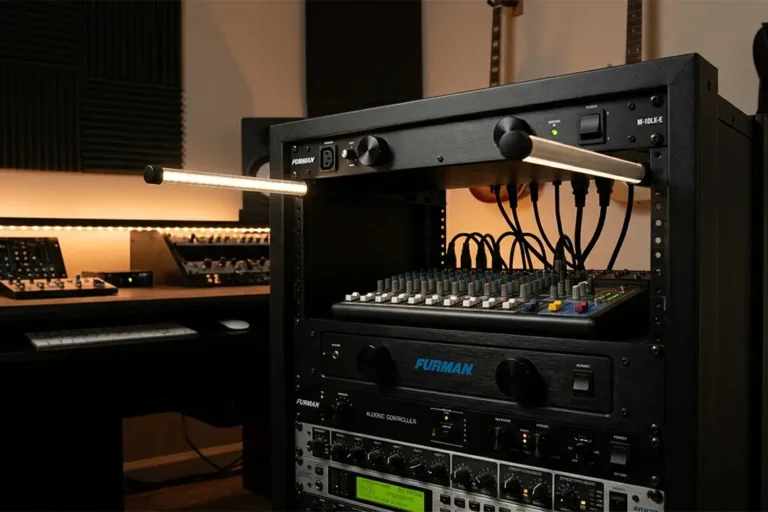
While standard surge protectors act as a basic shield, a dedicated power conditioner like the Furman M-10LX-E Power Conditioner serves as the central nervous system of a high-end audio or PC setup, especially in environments like Karachi, with unstable electricity.
Beyond simple surge protection, these units provide Linear Filtering Technology (LiFT), which scrubs “dirty” power—the annoying buzzes, clicks, or a high floor noise in studio monitors and recordings.
For professionals in Pakistan, the value lies in their ability to deliver a consistent, clean current that preserves the high-frequency clarity of audio gear and prevents the long-term degradation of sensitive PC components.
4. Stabilizers: When Do You Actually Need One?
If you live in an area where the voltage is constantly low, such as Baldia Town or Korangi, a Servo-Motor Stabilizer is necessary.
Avoid Relay-type stabilizers: These make a “clicking” sound every time the voltage fluctuates. This click is an arc of electricity that can introduce noise into your audio signal. Servo types provide a smooth, continuous adjustment that is much safer for delicate electronics.
5. Best Practices for Load Shedding Management
Even with the best gear, your habits matter:
1. The “Unplug” Rule: If a heavy thunderstorm is starting, unplug your PC and studio monitors physically from the wall. No surge protector is 100% effective against a direct lightning strike.
2. Monitor Your Load: Never run your PC, Studio Monitors, and a high-wattage device (like a laser printer or heater) on the same UPS.
3. Check Your Grounding: In many Pakistani homes, “Earthing” or grounding is either missing or poor. Without a proper ground wire, a surge protector has nowhere to “dump” the excess electricity.
Looking for pro audio gear or power solutions in Pakistan? Visit Ion Audio Visual for expert advice on studio setups and high-end equipment.
-
 PreSonus Studio 1824c USB-C Audio Interface
-
PreSonus Studio 68c USB-C Audio Interface
-
M-Audio AIR 192|8 USB Audio Interface
-
ICON Global U-MIX 101 Rack PRO Drive III USB Type-C Audio Interface
-
Icon Pro Audio Duo 44 Live USB Audio Interface
-
WiiM Ultra | Hi-Res Music Streamer & Audio Hub
-
Sheng BC-R-MIC Desktop Recording Microphone Stand
₨4,800
-
Noi Wooden Speaker Stands - Heavy Duty
₨18,500
-
Sheng 51B Microphone Boom Arm Stand
₨12,500
-
Sheng T3 Microphone Pop Filter
₨1,500
-
Sheng M-01 Universal Tablet & Phone Holder – Mic Stand Mount for Stage and Studio
-
Sheng Y-202B Studio Monitor Stand
₨9,500
-
Sheng P-08A Foldable Metal Sheet Music Stand
₨13,000
-
Lewitt LCT 440 PURE Large-Diaphragm Cardioid Condenser Microphone (Black)
₨130,000
-
Zoom H6studio 6-Track Handy Recorder with 32-Bit Float Recording
₨120,000
-
Zoom H6essential 6-Track 32-Bit Float Portable Audio Recorder
₨85,000